"Some artists are pure business on stage, others awash in theatrical gesture;
some look slyly amused by their fame, others jaded and maybe tired of the road. Jari Mäenpää, in a word, was joyous"
"When Hell freezes over." So the saying goes for impossible dreams or fates
forsworn. Flip the script (and thermometer) for a Chicago December without a single flake
of snow, and the stage is set for one such dream finally awaking. Not merely awaking—leaping
up from its slumber, sparkling with lightning, and striking off to conquer the world on
the solar winds of destiny. And why stop at the world? This conquest is boundless, cosmic,
eternal. This is Jari Mäenpää's Wintersun, the long-heralded arrival of 'Time', and
their first North American tour.
So maybe this overstates things a little. But for many fans in the metal world,
Wintersun's 2004 self-titled was an instant classic of millennial metal: a clinic of
neoclassical technique married to epic songwriting chops that maintained focus and a
thrilling momentum. This latter quality was the kicker, for while any number of
home-studio virtuosos can shred perpetually, 'Wintersun' was a front-to-back march of
indelible themes and seamless structures, all tinged with an inimitably arctic zest. It
was, in short, a do-your-worst gauntlet thrown at the feet of every other long-haired Finn
with a guitar, pretty much ever.
And then—eight years passed. Through endless tribulations and unexpected setbacks,
'Time' became a megalith in shadow, a white whale for the metal world, a metonym for
'never'. Only Necrophagist's follow-up to 'Epitaph', another 2004 masterpiece, could
command equal anticipation, speculation, and eventually for some, despairing resignation.
But Jari is as tireless as he is meticulous, and his bandmates—drawn into the fold
shortly after the self-titled's release—equally patient. And so at long last, in 2012
the march of 'Time' has begun in earnest, though in true literary form this tale will be
told in separate volumes, beginning with Time I'. A five-song album, it encompasses half
the material originally planned for the entire 'Time' album, with the capstone piece to
appear sometime in 2013. From here we could diverge into a study of 'Time I' itself, but
to consider its gestation and nuances could take nearly as long to read as it did to
produce the damn thing, so let's have on with the concert proper, which landed in Chicago
at the Bottom Lounge last Tuesday night.
Accompanying Wintersun on this tour were Varg, the rather punky pagan metalers from
Germany, and the tour's ostensible headliners, Eluveitie. This Swiss collective, helmed by
Chrigel Glanzmann, have been tireless bannermen for authentic folk metal since their
explosion onto the scene in 2004 and toured the States numerous times, drawing ever more
converts to their cause. Indeed, their legion of fans was out in force that night and the
photo pit absurdly brimming with shutterbug journalists. But as for myself—and the
majority of the crowd, judging by their response before and after the gig—Wintersun
eclipsed all else.
In the face of this singular focus, Varg opened the show with impressive commitment. Their
name means 'wolf' in some Germanic languages and the stage was covered with corresponding
imagery: snarling wolf faces silkscreened onto stage-mounted banners, metal-wrought
pendants a foot across dangling from chains on pillars capped with barren skulls full of
incisors. The band themselves were a tattooed and appropriately hirsute lot with faces
striped in red and black paint. The pattern looked copped straight from Turisas, frankly,
but the remainder of their aesthetic—cut-off black Ts, chains, middle fingers,
etc.—fell more in line with Belphegor. The two poles make for a fair counterpoint and
summation of the band, provided a healthy dose of Amon Amarth is thrown into the middle as
a binding agent. Certainly Varg are less brutal than Belphegor and to my knowledge have
never written a lyric about bondage, goats, zombies, or all three together. But the
snarling rasp of vocalist Freki, often in his vernacular German, is not far off from
Helmuth's own. Conversely, Varg don't dabble in the orchestral bombast or fur-lined armor
of Warlord Nygård and his Turisas cohorts, but they do wend plenty of folksy melodies
into their triple meter stomps and engage with the crowd in a comparably magnanimous
fashion.
An unexpected twist to their set was that the burly Freki delivered the higher, shriller
rasps, while the slender bassist Managarm, his short hair parted to the side and shaved
close around the ears, provided a muscular baritone roar in support. These two centered
the action on stage, swapping places periodically and showing the most movement, while two
impassive guitarists flanked them and churned out one pumping groove after another. The
audience responded with thrown horns and respectable moshpits, while Freki's
banter—classic "Canadia" bashing and an elementary German
lesson—helped their half-hour set flash by faster than I would have guessed possible.
Much of the material was drawn from their 'Wolfskult' and 'Guten Tag' records, but they
did also acknowledge a back catalogue that dates to '07. And naturally, it wouldn't be a
German metal band without at least one passage of whispered vocals, but even this was
blended successful into their live presentation.
On a broader note, I was also reassured to hear foreign language lyrics so readily
embraced by an American audience. Although the ubiquity of English is directly relatable
to metal's extraordinary reach, it's also inhibited the native expression of artists the
world over; for all its manifold styles and subgenres, the accompanying words and their
intonation are rather homogenized. If fans are so ready to explore new musical avenues,
why not welcome lyrics that are similarly challenging? Skål and/or Prost to Varg for
championing their roots; metal would be a richer world if more bands did the same.
 The ensuing layover was an anxious half hour made even more uncomfortable by the tide of
low frequencies swelling from the house speakers. At first I thougth someone's rig had
gone awry, since Wintersun uses Axe-Fx exclusively for their sound, eschewing live amps
and even using digital pitch shifting for one song. The tone—I hesitate to deem it a
'pitch', that being too tuneful—was persistent and so penetrating as to nearly chase
me from my second row spot, center stage. But on that verge a pattern of variations
suddenly became clear and I realized that nothing was broken—this was just Sunn O))).
In chatting later with Wintersun's non-Jari guitarist, the equally flight-fingered Teemu
Mäntysaari, he explained that their road crew is largely Hungarian and all quite rabid for
Sunn O)))'s particular brand of drudgery. So now we know, though it seems an almost absurd
non sequitur in retrospect.
The ensuing layover was an anxious half hour made even more uncomfortable by the tide of
low frequencies swelling from the house speakers. At first I thougth someone's rig had
gone awry, since Wintersun uses Axe-Fx exclusively for their sound, eschewing live amps
and even using digital pitch shifting for one song. The tone—I hesitate to deem it a
'pitch', that being too tuneful—was persistent and so penetrating as to nearly chase
me from my second row spot, center stage. But on that verge a pattern of variations
suddenly became clear and I realized that nothing was broken—this was just Sunn O))).
In chatting later with Wintersun's non-Jari guitarist, the equally flight-fingered Teemu
Mäntysaari, he explained that their road crew is largely Hungarian and all quite rabid for
Sunn O)))'s particular brand of drudgery. So now we know, though it seems an almost absurd
non sequitur in retrospect.
Regardless, the drone eventually dimmed and was replaced with a soothing swirl of
ambiance, faintly Asiatic chimes, and the orchestrated threnody of 'When Times Fades
Away', the luxurious (and four-minute) intro track to 'Time I'. The crowd tensed in
slow-motion, the lights dropped, and three men emerged onto the stage to pick up their
parts alongside the backing track. These were Kai Hahto (drums), Jukka Koskinen (bass),
and Teemu Mäntysaari (the aforementioned second guitarist). At last, Jari himself swooped
in and the fury commenced.
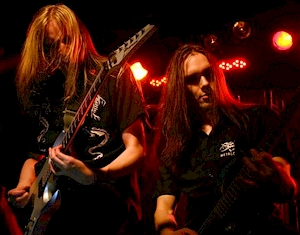
Some artists are pure business on stage, others awash in theatrical gesture; some look
slyly amused by their fame, others jaded and maybe tired of the road. Jari Mäenpää, in
a word, was joyous. Sporting black cargo shorts with a Wintersun patch and a
quasi-Japanese short-sleeve, he didn't look like an average a guitar god, but his charisma
was instantly affecting and his chops no less potent. With an exuberantly toothy grin
plastered across his long face, he swept across the audience like a floodlight and his
right hand thrust about like a conducting baton whenever free, lending an air of
proclamation to his delivery. Riding an impeccable blastbeat from Kai, he attacked the
microphone for the opening lines of 'Sons of Winter and Stars', the lead song from 'Time
I' and heir to 'Beyond the Dark Sun' as the band's official call-to-arms. The audience
responded, surging forward with fists raised, men and women both singing the words as
confidently as if they'd been doing it for years instead of mere weeks. One especially
animated fan in the front row flapped his arms during Jari's many references to flight,
and the two girls front and center on the barricade clasped hands and pumped them
triumphantly.
Until this tour, Stateside fans of Wintersun could only ever experience Jari as a
figurative presence perched beyond his mixing console somewhere and wrestling with
grandeur. I myself was aware of the band's various gigs and festival appearances in
Europe, but still never conceived of them as a live force. This performance blasted that
notion away for good on all accounts. The entirety of Wintersun played with exceptional
cohesion, utter conviction, and unimpeachable skill, front to back, left to right. Jari
was naturally the center of attention, equally at ease performing tight palm-muted
rhythms, his articulate and punchy growl, any number of lithe solos ('Battle Against Time'
was especially savory), and his increasingly adventurous clean vocals. On 'Time I' these
soar to new and more operatic heights than ever before, and I was duly impressed to see
them equaled in the live setting. Jari has often cited Devin Townsend as a major
influence, and though he shows little of Devin's demeanor on stage (really, could anyone
else pull it off), it's clear that Jari's put great effort into developing this avenue of
expression.
But this performance would have been something of a dud if his cohorts hadn't been able to
keep up, and that they did indubitably. Behind the kit Kai's expertise is assumed, and his
history with Rotten Sound and Swallow the Sun would mark him a superstar even without the
additional glow of Wintersun. On bass, Jukka has been a figure Finnish metal for more than
a decade, including a lengthy tenure in Norther. His presence on stage was boosted
(literally) by a pair of huge platform boots, but his aggressive attitude and background
management of stage positions define the corners of Jari's colorful frame. Completing the
portrait with accent and nuance is Teemu, a blossoming young guitarist who wrote to Jari
soon after hearing the self-titled to propose himself as a companion. It was a bold move,
but one backed by copious talent that Jari did well to recognize. Though not so giddy a
performer as Jari, Teemu also looked mighty pleased to be on stage, sliding in and through
solos with grace and occasionally cutting a few poses worthy of fellow Ibanez players Joe
Satriani and Steve Vai. No doubt he's a lifelong student of those masters, the latter
especially.
On that gear note, all three instrumentalists were playing Ibanez—Jukka a 5-string
wenge/bubinga Soundgear Prestige, Jari his custom 25.5" scale RGD (1" shorter
than production models), and Teemu his old J-Custom, bought used years ago, and his
resplendent new LACS RGA, replete with a 12th fret inlay of the Japanese character for
'Time'. The latter is a joy to look upon and a dream to play, brief though our encounter
was before the show. With some current endorsers plumbing 7 and 8-string depths for ever
chuggier forms of American prog/djent/quantize-core, Ibanez would do well to promote this
pair as beacons of their enduring brand.
Offstage hands directed the Axe-Fx channel-switching, which beyond just opening up the
made song changeovers faster and also achieved a closer parity with the album
arrangements—occasional acoustic emulation, more tones than just 'Drive' and 'Solo
Boost', and so forth. Though I still am not sold on solely digital rigs, their convenience
and reliability are undeniable, and the sounds they produce come dangerously close to the
real thing. 'Land of Snow and Sorrow', for instance, is played in Drop-Bb, but the band
was still able to play D standard guitars and just shift the output down the appropriate
interval. Latency is negligible, and had Teemu not given me the rundown of their rig
before the show, I doubt I'd have noticed the trick. But I would not call it trickery,
since each member was still entirely responsible for his product on stage. Indeed, the
nature of the mix may have even made it harder to hide mistakes: unlike the record, it
favored combo instruments over orchestration and would split one guitarist's signal to
cover both rhythm outputs when his counterpart took a solo.
The band was companionable with the crowd, but spent little time reminiscing on past
challenges or chatting us up. Most nights on this tour the members have been accessible to
fans after the show, for those willing to wait, so better to let the music speak while on
the stage. Their chosen script: 'When Time Fades Away', 'Sons Of Winter And Stars', 'Land
Of Snow And Sorrow', 'Battle Against Time', 'Death And The Healing', 'Darkness And Frost',
'Time', 'Beyond The Dark Sun', and 'Starchild'. It was an unsurprising but satisfying
setlist for this tour, and a deservedly lengthy one. Though they did not close the night,
Wintersun were treated as headliners by the crowd and gave us the full-band bow as
acknowledgement before snapping a group photo with the audience, a habit they've
maintained through this tour and others lately that's endearingly unpretentious. And then
they were gone, leaving us blitzed and euphoric.
 I could have left satiated at that point, but as some wandered back from the barricade,
sweaty and spent, others in Eluveitie garb took their place. The official headliners had
yet to hit the stage, and I was inclined to observe what changes had been wrought since I
last saw them in 2008. Though I can't report any impression to equal that left by
Wintersun, after Eluveitie's night-closing set I was glad to have stayed. Few metal bands
have committed so completely folk instrumentation and ideology without falling prey to
camp, and Eluveitie may be foremost among them.
I could have left satiated at that point, but as some wandered back from the barricade,
sweaty and spent, others in Eluveitie garb took their place. The official headliners had
yet to hit the stage, and I was inclined to observe what changes had been wrought since I
last saw them in 2008. Though I can't report any impression to equal that left by
Wintersun, after Eluveitie's night-closing set I was glad to have stayed. Few metal bands
have committed so completely folk instrumentation and ideology without falling prey to
camp, and Eluveitie may be foremost among them.
For this tour the band is playing their latest album, 'Helvetios', in its entirety. This
itself is an hour-long proposition, which the band then followed with a lengthy encore
heavy on old fan favorites ('Inis Mona') and demo-days material like 'Lament' and
'Divico'. Bringing this all to the stage, be it on this side of the Atlantic or any other,
Eluveitie bring out a full crew of participants—eight in all, with three folk
instrumentalists added onto the typical constitution of two guitarists, bassist, drummer,
and vocalist. Chrigel handles nearly all lead vocal duties, but beyond that plays an array
of pipes and fretted folk instruments. When he takes one up, dreadlocks falling about his
shoulders, fingers glittering with heavy rings, and his flashing palms branded with
Celtic-patterned tattoos, it's obvious that the heathen heart of Eluveitie is true.
The unfortunate consequence of this folk-forward style is that the metal component almost
invariably suffers. And though the two guitarists (old hand Ivo Henzi and touring member
Rafael Salzmann) were capable and enthusiastic, their performances felt quite tame. Too,
after about 45 minutes of material—hardly half the total set performed—most
songs began to fall into the same sort of sing-songy sway. Another 20 minutes of Chrigel's
evenly measured growls, open-neck black button-up, and Gothenburg-style drumbeats and one
begins to wonder just how much inspiration they've taken from Dark Tranquillity over the
years. But whereas Mikael Stanne's presence and voice are ageless (as yet), Chrigel's is
increasingly weary and breathy. His growls were never too hefty, though, and a set of this
length would drain any performer, much less one who plays other wind instruments when not
singing. So let it never be said that Eluveitie do not give up their all to the audience.
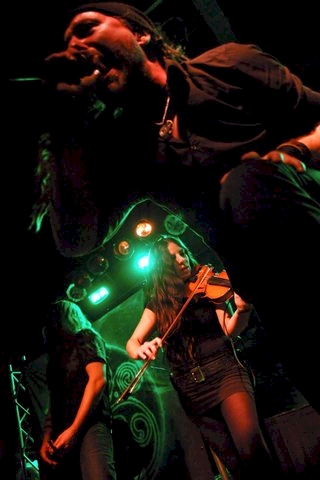
Aside from Chrigel's dominating presence, Eluveitie's top podium is rounded out by two
diminutive brunettes: Meri Tadic on fiddle, Anna Murphy on hurdy-gurdy and vocals. The
former smirks and swirls her hair from afar; the latter beams and hands out flowers. But
Anna is capable of more than charm: her almost-a cappella rendition of the lament
'Scorched Earth' was unhinged pathos, leagues beyond the recorded take on 'Helvetios'. A
couple other passages smacked a little too much of Evanescence—'A Rose for
Epona'—but altogether the ancient spirits won out over the alternative. Throughout it
all Chrigel and company showed great gratitude to the crowd at every opportunity and their
fans responded in kind, if not quite as maniacally as after Wintersun's set.
Naturally, that piqued frenzy is expected when a band of this stature debuts on foreign
soil, putting the more traveled Eluveitie at a bit of a disadvantage. But it is a
testament to their ongoing success that they commanded such a crowd until the very end. As
for Wintersun—they were purely a pleasure. Utterly professional, and no shadow of
bitterness over lost years, only elation and passion for the experiences made today. To do
elsewise would admit defeat in their battle against time—a doom unacceptable to the
Sons of Winter and Stars, whose 'worlds will never die'. Amen. Now where's my celestial
steed? Those cosmic winds are calling....